PAINTING / MEMORY / CONSCIENCE

Images for the spirit.
A theatre of conscience.

Jan Maria Tomaszewski’s painting does not pursue easy beauty. It invites us to look attentively into a world of memory, unease, symbols and questions that resist simple answers.

READ ON ↓
01 / 05ABOUT THE ART

The artist and his language

Jan Maria Tomaszewski is a Polish painter and graphic artist. He graduated from the Academy of Fine Arts in Warsaw, where he studied painting in Rajmund Ziemski’s studio. His work brings together the discipline of academic drawing and composition with a deeply personal, often symbolic imagination.

His family’s artistic heritage is an important part of this story. His father, Stanisław Władysław Miedza-Tomaszewski, was a versatile artist whose life was also shaped by war and underground resistance; his mother, Irena Jasiewicz, was a painter. Both were closely associated with the Warsaw Academy of Fine Arts.

Tomaszewski’s work rests on the conviction that art is more than decoration. It can bear witness, enter into dialogue with history and confront the human conscience.
02 / 05ABOUT THE ART

Drawing, form and painterly matter

Drawing is not merely preparatory in these works. It is a way of thinking, constructing and bringing order to expression. Even where death, fear or chaos are the subject, the discipline of form remains palpable.

The artist works with a painterly medium that demands time. Layers of paint build tension between figure and sign, light and half-light, gesture and silence. The paintings do not tell a single, closed story; they leave room for viewers to form their own readings.

His work draws on Polish painting as well as a wider European visual heritage, from religious iconography and morality plays to expressive visions related to the historical tradition of memento mori.

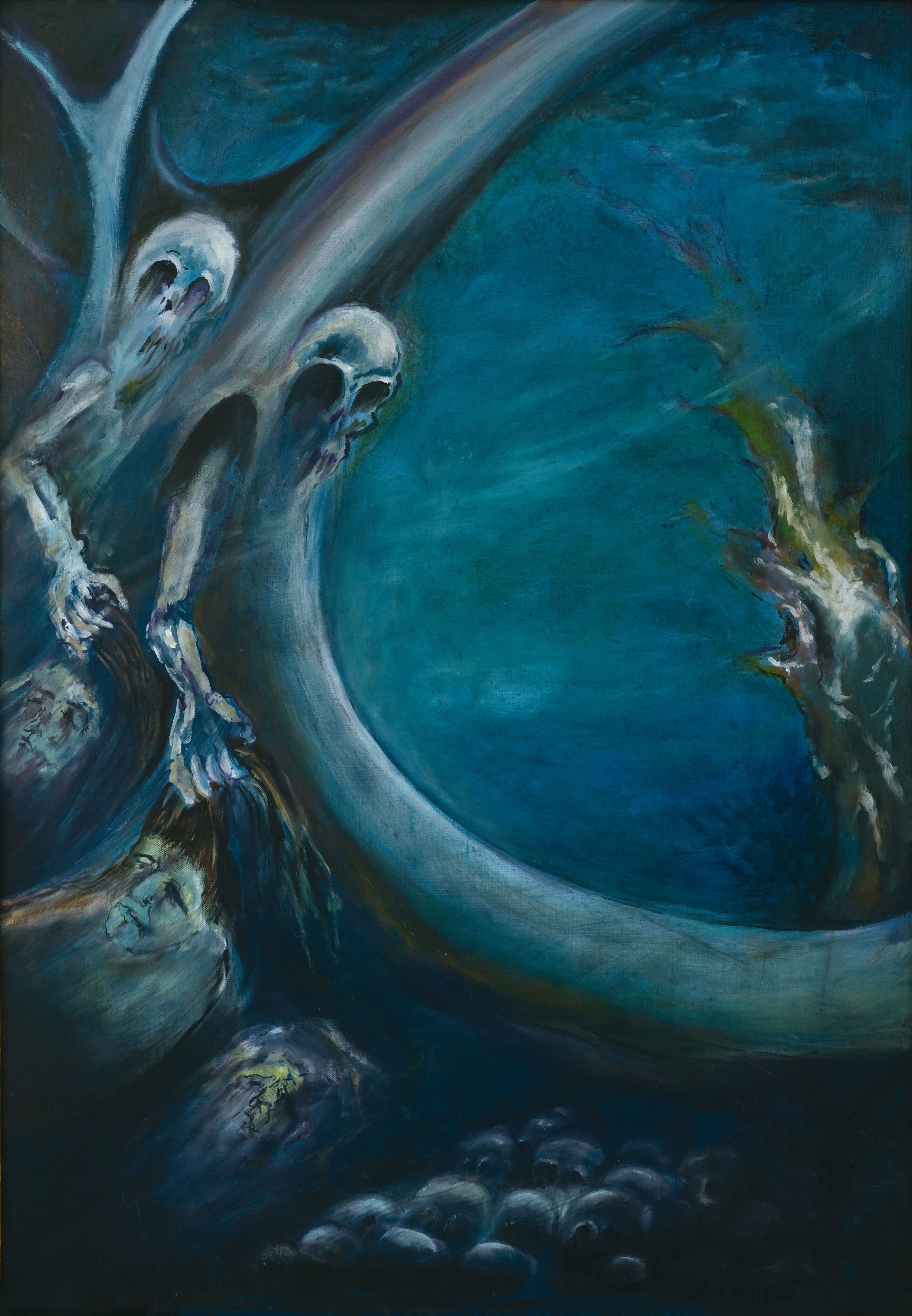
Memento Mori
03 / 05ABOUT THE ART

Memento mori and the theatre of conscience

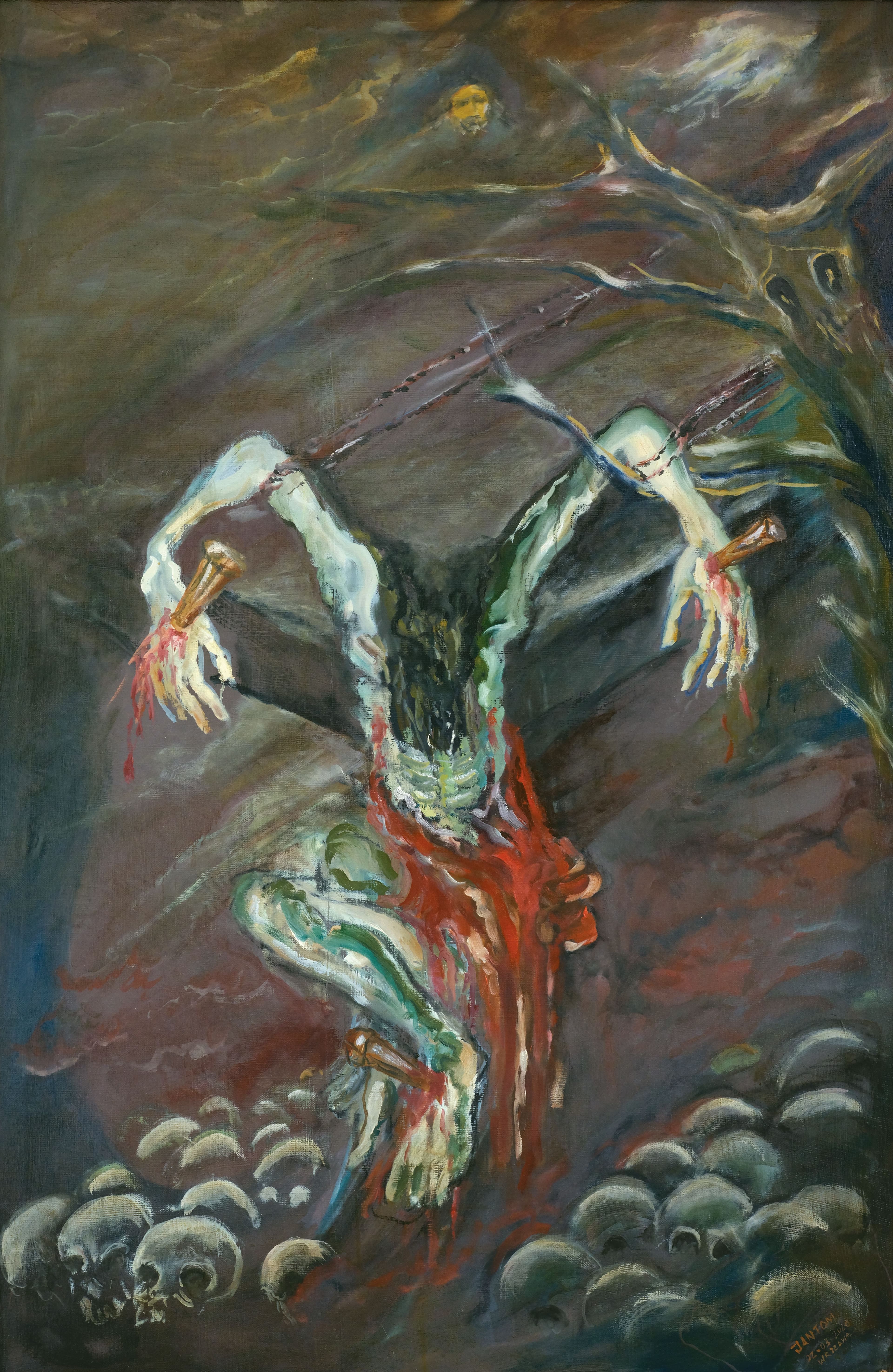
Figures of death, skulls, skeletons, angels, animals, processions and characters resembling participants in mysterious rituals recur throughout the paintings. Yet they are not a catalogue of horror. They direct attention to the fragility of life, memory, guilt and moral responsibility.

The pictorial space becomes a stage on which a spiritual drama unfolds. Viewers are not handed a ready-made judgement. They encounter fragments of a narrative that they must piece together for themselves.

The sacred and the profane coexist without a simple division. Religious symbols stand beside the body, fear and irony, while traditional motifs acquire a contemporary and unsettling force.

04 / 05ABOUT THE ART

Humanity, community and the bestiary

Animals, birds, hybrids and figures on the threshold of humanity are more than fantastical ornaments. They form a distinctive bestiary — a language reflecting human instincts, frailties and collective behaviour.

Groups of figures, parades and processions can be read as images of community: its rituals, hypocrisies, fears and repeated gestures. The paintings do not single out one person or event; instead, they ask about experiences that recur across eras.

At the centre stands a person confronting a limit — death, loneliness, the loss of meaning or the burden of memory. The painting becomes a mirror that does not always show us what we wish to see.

Golgotha
05 / 05ABOUT THE ART

Art that demands time

These paintings cannot be exhausted in a single glance. They ask for concentration, stillness and an acceptance of ambiguity. Rather than offering a definitive interpretation, the artist proposes an experience of looking.

In 2020, Tomaszewski presented the exhibition ‘Wyrzut sumienia’ in Warsaw, featuring 15 paintings and 13 sketches. In 2026, his works were shown in an exhibition at the European Parliament in Strasbourg.

The exhibition ‘Obrazy dla ducha. Teatr sumienia’ (‘Images for the Spirit. A Theatre of Conscience’) continues this journey: from craft and drawing to the painting as a place of memory, reflection and encounter.

“A painting need not soothe. It may unsettle us — and stay with us all the longer.”
EXPLORE THE GALLERY ↗

ABOUT THE SOURCES

An editorial synthesis based on the supplied exhibition materials: the biography ‘Jan Maria Tomaszewski’, the essay ‘Obrazy dla ducha. Teatr sumienia’, and ‘Zamiast podziękowań’ by Dr Jędrzej Karol Lipski. The texts are paraphrased and are not verbatim reproductions.

Art of Jan Maria Tomaszewski — Paintings & Symbolism